Fascism 101
-
![Group of men marching on cobblestone street, some wearing military uniforms with medals, others in suits, in black and white photograph.]()
Origins and Intellectual Foundations
Fascism’s roots trace back to late 19th‑century reactionary thought, where writers and theorists across France, Germany, Austria, and Italy criticized Enlightenment ideals, liberal democracy, and social equality. Thinkers such as Joseph de Maistre, Charles Maurras, Georges Sorel, and Giovanni Gentile contributed ideas about hierarchy, nationalism, mass psychology, and the need for strong authority. These ideas gained traction amid the political and social upheavals following the revolutions of 1789–1871 and the anxieties created by rapid modernization.
-
![A man with gray hair in a blue sweater and beige pants is sitting on a cushioned surface, with one hand resting on the surface and the other arm hanging down. He is looking to the left, against a plain, neutral-colored background with a shadow cast on the wall.]()
Rise After World War I
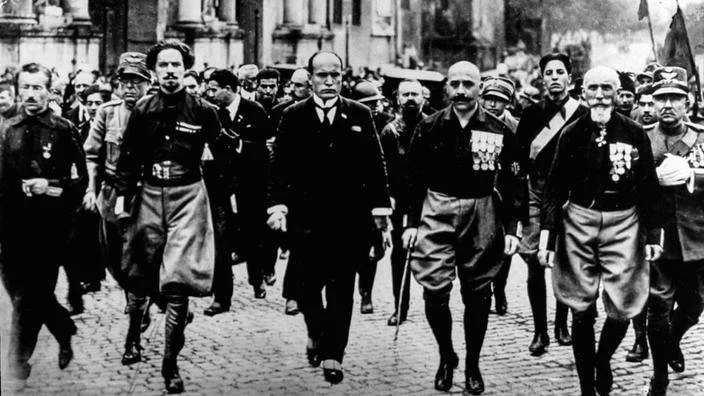
The First World War was a turning point. The brutality and total mobilization of society during the war normalized mass participation, militarism, and state power. Fascists interpreted the war as proof that violence and national unity could regenerate society. In 1919, Benito Mussolini founded the Partito Nazionale Fascista in Italy, marking the first organized fascist movement. Italy’s postwar instability—economic crisis, social unrest, and fear of socialism—created fertile ground for fascism’s rise.
-
![A woman with curly hair wearing a beige sleeveless top and light brown pants sitting on a bench, with sunlight casting shadows on the wall behind her.]()
Core Characteristics
Across countries, fascist movements shared several defining traits:
Ultranationalism and the belief in national rebirth
Authoritarian leadership embodied in a single charismatic figure
Militarism and celebration of violence as purifying
Suppression of opposition, pluralism, and individual rights
One‑party rule and rejection of liberal democracy
State‑directed economy aimed at national self‑sufficiency
In‑group vs. out‑group ideology, often including racism and antisemitism (especially in Nazism)
-
![A young man with dark skin and short hair, wearing a gray polo shirt and beige pants, is sitting on a cushioned bench against a light-colored wall. He is looking thoughtfully to his right, with one hand resting on his thigh.]()
Expansion Across Europe
After Mussolini’s success, fascism spread:
Germany: Adolf Hitler’s Nazi Party took power in 1933, creating the most extreme and genocidal fascist regime.
Spain: Francisco Franco established a long‑lasting authoritarian regime after the Spanish Civil War.
Eastern Europe: Movements such as Romania’s Iron Guard, Hungary’s Arrow Cross, and Croatia’s Ustaše adopted fascist or fascist‑inspired ideologies.
Fascist movements also appeared in France, Austria, Latin America, and elsewhere, though not all achieved state power.
-
![View of the moon's cratered surface in the foreground with Earth visible in the distance against the blackness of space.]()
Fascism in World War II
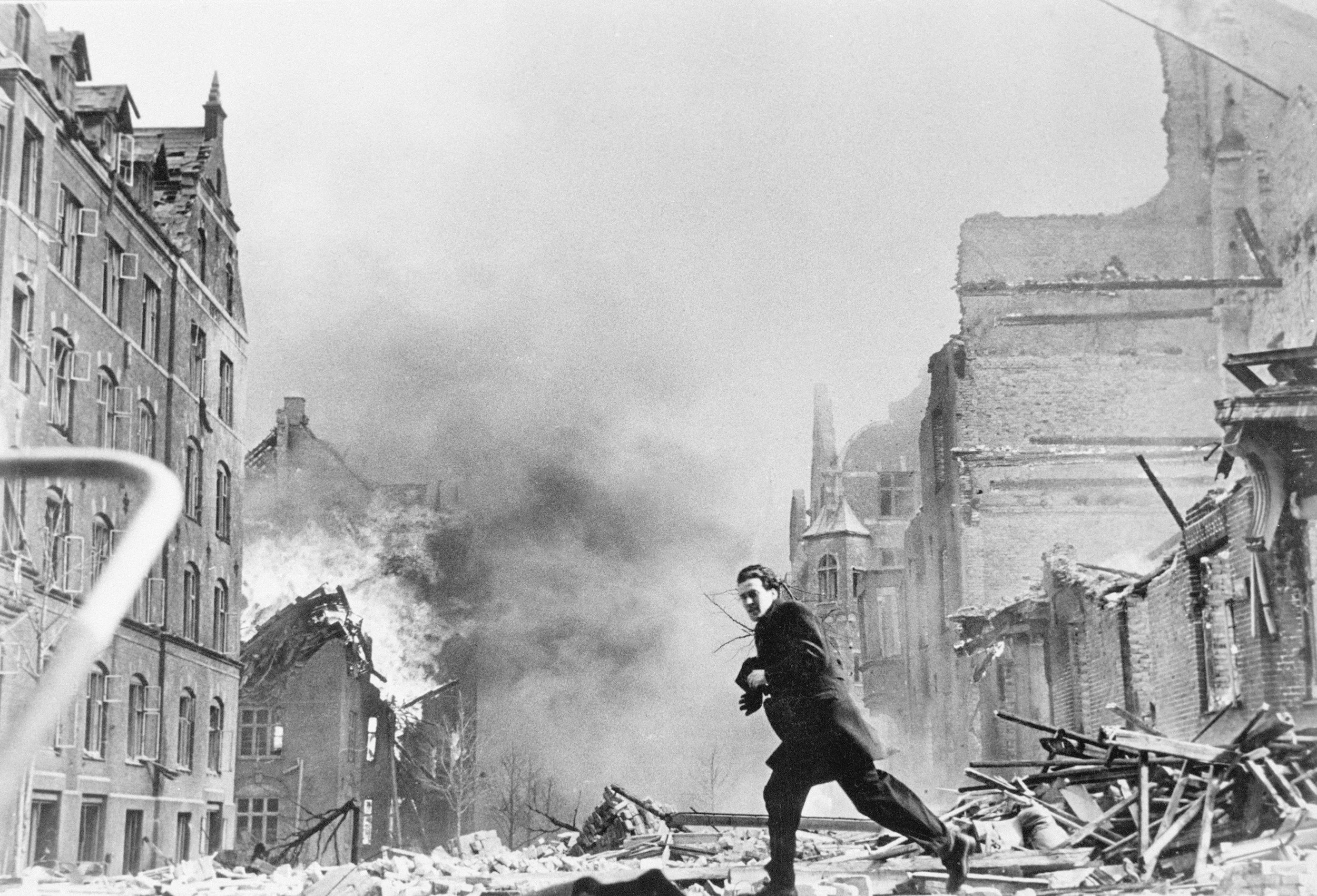
Fascist regimes played a central role in the outbreak and escalation of World War II. Nazi Germany’s racial ideology led to the Holocaust, the systematic genocide of six million Jews and millions of others. The defeat of the Axis powers in 1945 ended classical fascist governments, though many collaborators and institutions persisted for years.
-
![View of the Earth from the moon's surface, with darkness of space surrounding it.]()
Postwar Legacy and Neo‑Fascism
After 1945, fascism became widely discredited, but neo‑fascist movements emerged in Europe and the Americas. These groups often rebranded their ideology while retaining ultranationalist and exclusionary principles. Scholars continue to debate how fascist ideas reappear in modern politics, emphasizing the need for historically grounded analysis.



Intellectual Foundations
According to Britannica, fascist ideas did not suddenly appear in the 20th century; they originated in the 19th century among writers who rejected the political and cultural transformations unleashed by the revolutions of 1789, 1830, 1848, and 1871.
These thinkers shared several themes:
Hostility to Enlightenment universalism
Defense of hierarchy and traditional authority
Distrust of mass democracy
Nationalism rooted in ethnic or cultural identity
Belief in the regenerative power of violence or myth
How Fascism Affects Governments
Fascism affects governments by concentrating power in the hands of a single leader, dismantling democratic institutions, and suppressing political opposition. Under fascist rule, legislatures and courts lose independence, becoming tools of the ruling party, while competing political parties are banned or intimidated out of existence.
The state expands its control over society by dominating education, media, labor, and cultural life, shaping citizens’ beliefs to align with the regime’s ideology. Civil liberties such as free speech, free press, and the right to assemble are sharply restricted through censorship, surveillance, and policing. Fascist governments also militarize politics, elevating discipline, hierarchy, and nationalism, which often leads to aggressive foreign policy and internal repression.
Economically, they use corporatism to control major industries and labor groups, limiting worker rights and aligning economic activity with political goals. Over time, these practices weaken institutions, polarize society, and leave lasting damage that can take decades to repair even after the regime falls.
Thinkers and Their Contributions
Benito Mussolini — Political Architect of Fascism
Mussolini is widely recognized as the founder of the National Fascist Party in Italy and the first major fascist dictator. His regime (1922–1943) established the core political model of fascism: a one‑party authoritarian state, suppression of dissent, and aggressive nationalism. Mussolini’s leadership provided the practical blueprint for fascist governance, influencing similar movements across Europe.
Giovanni Gentile — “Philosopher of Fascism”
Gentile, an Italian idealist philosopher, supplied the intellectual foundation for fascism. His doctrine of actual idealism argued that individuals exist only through the state, justifying totalitarian control. Gentile’s writings framed fascism as a unifying spiritual and political force, helping Mussolini legitimize authoritarian rule.
Friedrich Nietzsche — Precursor Through Critiques of Morality
Although Nietzsche was not a fascist, early fascist thinkers drew heavily on his ideas. His concepts of the “will to power” and critiques of traditional morality inspired fascist emphasis on strength, hierarchy, and the rejection of liberal values. Fascist ideologues selectively appropriated his work to justify authoritarianism and elitism.
Georges Sorel — Influence Through Myth and Violence
Sorel, a French theorist, shaped fascist ideology through his ideas about political myth and the redemptive role of violence. His notion of the “myth of the general strike” influenced early fascists, who adapted it into a belief in mobilizing society through powerful national myths and sanctioned violence.
Adolf Hitler — Leader of German Fascism (Nazism)
Hitler adapted fascist principles into Nazism, emphasizing racial ideology, totalitarian control, and expansionism. His regime (1933–1945) represented the most extreme and destructive form of fascism, shaping global understanding of the ideology.
Other Political Figures Who Shaped Fascist Movements
Several leaders contributed to regional variants of fascism, including:
Francisco Franco (Spain) — authoritarian nationalist regime.
Corneliu Codreanu (Romania) — founder of the Iron Guard, merging fascism with religious mysticism.
Oswald Mosley (UK) — leader of the British Union of Fascists.
These figures adapted fascist principles to local contexts, expanding the ideology’s reach.